Free Printable Resources
Printable Patterning Activities –
Free Logic Activities
Expertly designed patterning worksheets to boost logical reasoning, sequencing skills, and early math readiness in preschoolers. 100% screen-free.
Why Teach Patterns in Preschool?
Patterns are the heartbeat of mathematics. By learning to identify, extend, and create patterns, children develop the ability to make predictions and understand logical sequences. This skill is a vital stepping stone for learning everything from basic addition to complex coding and scientific reasoning later in life.
Available Worksheets
-
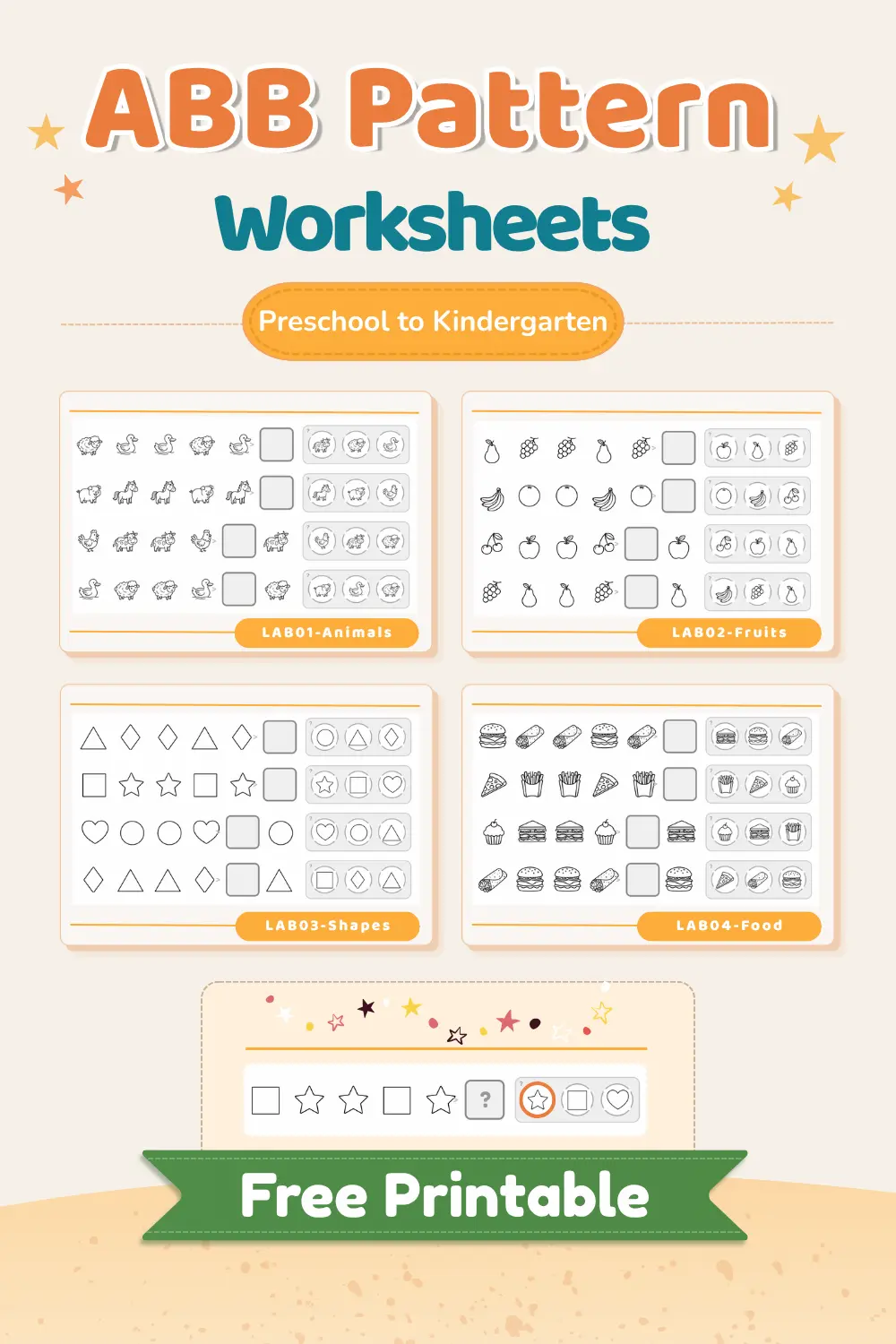
Free ABB Pattern Worksheet for Preschool — Bilingual Printable Activity (Ages 4–5)
Ready to move beyond the AB pattern? This free bilingual ABB pattern worksheet helps children ages 4–5 practice more complex sequences — in Spanish and English. No sign-up needed.
-
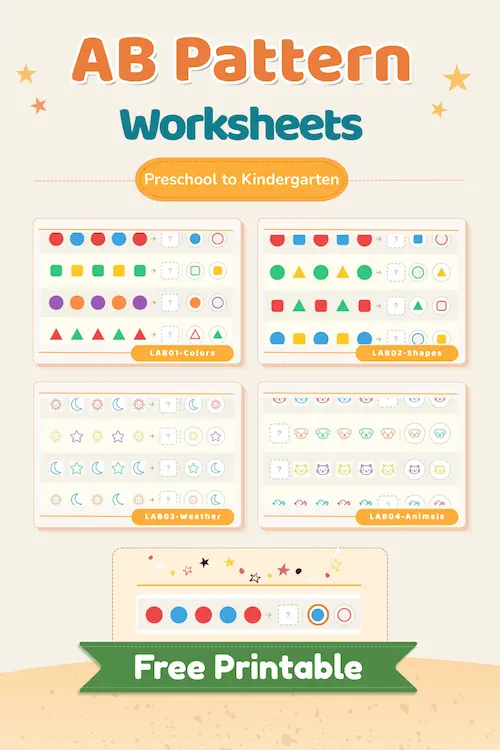
Free Bilingual AB Pattern Worksheets — Spanish & English Printables for Preschool (Ages 3–6)
Instructions appear in both English and Spanish on every sheet — ideal for bilingual families and dual-language classrooms.
What Skills Do Patterning Activities Develop?
Lab Note
Patterns help children move from ‘seeing’ to ‘analyzing.’ When a child identifies an AB or ABC sequence, they are actually practicing the same logical structure used in advanced problem-solving.
Family Bridge
Benefits for Families
Bilingual Families
Ideal for U.S. families bridging the gap between Spanish at home and English at school.
How to Use These Patterning Worksheets
Start with AB Patterns
Begin with the simplest sequences (red-blue-red-blue) to build confidence.
Say it Out Loud
Have your child name the pattern out loud. Hearing the rhythm helps them internalize the sequence.
Use Manipulatives
Try duplicating the pattern on the worksheet using real objects like LEGOs or fruit snacks.
Create Your Own
After completing a worksheet, challenge your child to draw or build their own original pattern.
Frequently Asked Questions
Are these pattern worksheets free?
Yes! All our patterning resources are 100% free to download and use at home or in the classroom.
What types of patterns are included?
Our collection covers AB, AAB, ABB, and ABC patterns, ranging from beginner to intermediate levels.
At what age should kids start learning patterns?
Most children can begin recognizing simple patterns around age 3. These worksheets are optimized for ages 3 to 6.